



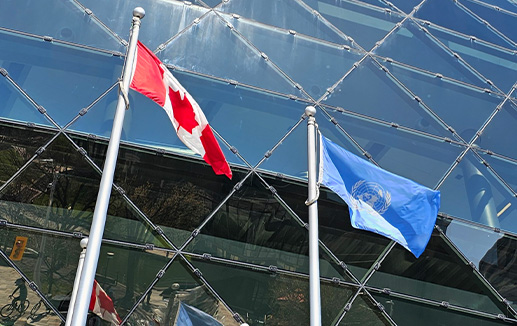
Global negotiators working toward a treaty to end plastic pollution made limited progress this past week, crafting a streamlined draft text that advances several options for limiting chemicals of concern (CoCs) and designing products for greater circularity, but failing to agree on more ambitious language.
Action came in the final week of April at the fourth meeting of the intergovernmental negotiating committee (INC-4) in Ottawa, Canada. Delegates from some 170 countries met to advance a "zero draft" text into a manageable form they hope can be finalised during a fifth meeting (INC-5) in Busan, South Korea near the end of the year.
While consensus remained elusive in several areas, negotiators in Ottawa agreed to set up ‘intersessional discussions’ with a technical working committee tasked with analysing methods for identifying and addressing CoCs, problematic plastics and product design. Another working group will focus on financial mechanisms, technology transfer and capacity building for developing nations.
These discussions are expected to start in late August or early in the autumn.
This additional work will create a "foundation for governments to identify additional areas of convergence", said Stewart Harris, a spokesperson for the International Council of Chemical Associations (ICCA). "Hopefully, we can build on that to complete negotiations by the end of the year," he told Chemical Watch News & Insight.
Most participants acknowledged the large amount of work left to finalise a treaty. At the conclusion of INC-4, the developing text includes some 70 pages and rows of language in brackets yet to be agreed on.
Many NGOs and civil-society groups also decried efforts by the so-called like-minded group of nations – including Saudi Arabia and other fossil fuel-producing countries – to push discussions towards design, recycling and waste management action over more ambitious efforts to address chemicals and plastic production.
David Azoulay, environmental health programme director for the Center for International Environmental Law (CIEL), said there is now a dichotomy between countries that are articulating their position for action based on facts, versus countries that are doing so based on their own short- and medium-term interests.
'Convergence on design’
Steven Guilbault, environment minister for host country Canada, said at the close of the INC-4 talks that delegates made headway towards the goal of landing on a final agreement in Busan. He outlined three key pillars that he said should be included in a final agreement:
- eliminating or restricting problematic and avoidable plastics and CoCs;
- establishing clear targets for action; and
- developing criteria or other targeted action to enable reuse and recycling of plastic.
"We are no longer talking about ‘if’ we can get there, but ‘how’," he said.
ICCA's Harris agreed that there is "convergence around the need for some kind of guidance" around product design. "Design is key to our members," he told Chemical Watch News & Insight. "It’s key to a circular economy."
Options on product design include establishing "minimum design and performance criteria" for plastic products to increase their durability and recyclability and reduce the demand for primary plastic polymers.
How to tackle CoCs
There was less agreement on how a final treaty should address CoCs in plastics.
The draft text includes multiple options to address CoCs, including a recent proposal from Norway, Rwanda and the Cook Islands to ban the use of several phthalates, bisphenol A, heavy metals and more.
All three countries are part of the High Ambition Coalition to End Plastic Pollution, a group of more than 60 countries committed to aiming high in the negotiations to end plastic pollution by 2040.
The countries’ proposal would also call for a general reduction in the use of all phthalates, bisphenols and per- and polyfluoroalkyl substances (PFAS) and set out potential hazard criteria for listing additional CoCs.
Another option in the draft text would avoid listing specific chemicals or classes of substances and instead call on member states to control chemicals that are listed under the Basel, Rotterdam or Stockholm conventions (BRSs).
According to Harris, this is "clearly a topic where governments want more information", but it is not clear there is "convergence" on these provisions.
He said the ICCA does not support including CoCs in a plastic pollution treaty.
Chemicals already are managed at the national level and in other international agreements, he said. It is more important for every country to implement their own chemical management system, he added, and there is an opportunity through this agreement to support those countries that do not yet have systems to obtain the chemical information they need.
Road ahead
The International Pollutants Elimination Network (IPEN) expressed a mix of optimism and concern at the direction of the talks.
For the first time since intergovernmental talks began in late 2022 there is a draft text "outlining pathways toward a global agreement", with options for addressing overproduction of plastic and eliminating toxic chemicals throughout the plastics lifecycle, the global NGO said.
But it cautioned that options for these provisions "remain contentious" and noted "strong industry lobbying" pushing for more recycling, despite increasing evidence of the health and environmental threats posed by the spread of toxic chemicals from plastic recycling.
Azoulay said work will continue despite industry lobbying and the wishes of the like-minded countries.
The need to deal with plastic pollution is on the general public’s radar and set in the global agenda, he said. "This issue is not going to disappear."