



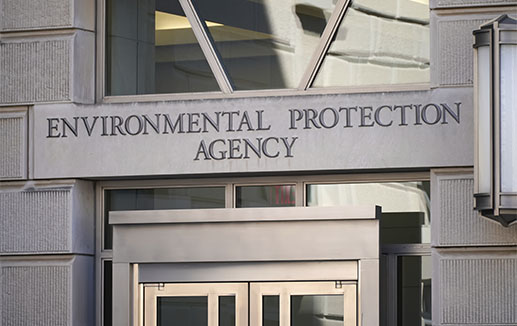
 © John Hanson Pye stock.adobe.com
Recent actions by the Trump administration to cut the federal workforce could hinder the US EPA’s ability to review, approve and regulate chemicals under the TSCA programme, multiple stakeholders have told Chemical Watch News & Insight.
In the weeks since the president reoccupied the White House on 20 January, the new administration has issued executive orders seeking to limit collective bargaining agreements with federal workers, reform federal hiring, require employees to return to in-person work, and reclassify career employees in a way that makes them easier to hire and fire.
The US Office of Personnel Management (OPM) also offered to buy out federal employees if they agree by 6 February to voluntarily leave, while some 1,100 EPA staff have reportedly been notified that they are on "probationary" status and could be fired immediately.
Cumulatively, these actions could result in more workers leaving the government and the EPA, especially those with high levels of expertise. This could compound delays in the new chemicals programme which, despite some recent improvements, have long frustrated many in industry.
A potential disruption in staffing and expertise could also delay the agency’s work on existing high priority chemicals, further straining a programme already facing a long list of overdue and new actions to complete.
‘Increased backlog’
Robert Helminiak, vice president of legal and government affairs at speciality chemicals group SOCMA, believes the recent executive actions "are likely to strain the EPA’s ability to effectively implement" TSCA, particularly in reviewing new chemical submissions.
Reducing the workforce "would almost certainly lead to increased backlogs rather than improved efficiency", he said. "Fewer resources mean slower regulatory approvals, which would delay innovation and hinder the ability of businesses to bring new chemicals to market."
Betsy Southerland, a former EPA official who is now a member of the NGO Environmental Protection Network (EPN), remarked that she is "particularly worried about the TSCA programme" and the EPA’s Office of Chemical Safety and Pollution Prevention (OCSPP), which is already short of staff and resources.
Rich Engler, director of chemistry at law firm Bergeson & Campbell, said the "early retirement offers will undoubtedly exacerbate the brain drain at OCSPP", adding that the effort to replace highly experienced staff dates back to at least the Obama administration.
Unfortunately, he added, "there has been little regard to the loss of the associated institutional knowledge".
Impact on TSCA work
Helminiak said chemical risk evaluations under TSCA section 6 and the section 5 new chemical review process "are most likely to be affected first and most severely" if there are steep cuts to the EPA workforce, because these programmes require significant resources.
Delays in these programmes "would result in significant barriers to innovation and advanced manufacturing", he said. For speciality chemical manufacturers, this could lead to:
- longer timelines for regulatory approvals, which could delay the introduction of new products;
- increased compliance costs; and
- greater uncertainty in supply chains, reducing efficiency and responsiveness to market demands.
"SOCMA has urged policymakers to ensure a stable regulatory framework to mitigate these challenges," Helminiak commented. "A streamlined and properly funded and focused EPA can enable businesses to invest confidently in innovation, meet market demands more effectively, and maintain global competitiveness."
With the workforce actions, the president is effectively "cutting off his nose to spite his face", said Kyla Bennett, director of science policy at the NGO Public Employees for Environmental Responsibility (PEER).
Dr Bennett pointed to a recent report from the Government Accountability Office (GAO), in which representatives from multiple manufacturers told the watchdog that a shortage of assessors was contributing to delays in EPA reviews and approvals of new chemicals.
The OSCPP needs "double, triple the people" it has to conduct pesticide and chemical reviews. She questions how cutting staff is going to help industry.
Dr Southerland said other potential actions could further delay the EPA’s work. She pointed to the Project 2025 framework’s calls to "revisit" a new chemicals procedural rule finalised under the Biden administration and to "right-size" TSCA fees as initiatives that could drive uncertainty and strain overstretched employees.
Other pressures
Maria Doa, a former EPA official who is now the senior director of chemicals policy with the Environmental Defense Fund (EDF), said the scientists, engineers and other staff who remain could feel pressure to achieve certain political policy goals.
During her final years at the agency under president Trump’s first term, "there was constant pressure to change scientific and technical analysis on risk management actions", Dr Doa noted.
This could also exacerbate delays in the TSCA programme, she said.
In the new chemicals programme, you could see more pressure on staff to come up with certain analysis and certain decisions, Dr Doa observed, which could add to gridlock where staff are asked to do certain things that they do not think the scientific data supports.
Bergeson & Campbell's Engler highlighted that another troubling issue is the administration’s call for certain agencies to avoid communication with any outside groups.
"TSCA and FIFRA stakeholders rely heavily on frequent, detailed and technical discussions with OCSPP staff and managers," he said. "Prohibiting EPA employees from communicating with submitters/registrants will undoubtedly delay and likely undermine the robustness of EPA decisions."
It is also possible that the administration’s effort to cut the federal workforce could backfire, according to Bennett with PEER, which is one of several organisations that have sued the federal government over its efforts to weaken protections for federal workers.
"People are demoralised and scared," she said, but even more so they are furious at the notion of political leaders calling them ‘low productivity workers’, Bennett said.
Federal employees "don’t work at EPA for money or fame, they want to help the environment", she said. "For them to be maligned this way, they are pissed off. I’m proud of them."