



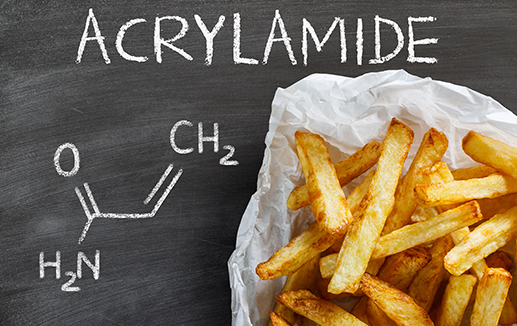
 © airborne77 stock.adobe.com
A federal district court has permanently blocked California from enforcing its Proposition 65 warning requirement for acrylamide in food and beverages, on the grounds that it violates the US Constitution.
The 2 May decision from the US District Court for the Eastern District of California marks the latest legal victory for industry groups using the First Amendment’s protections against compelled speech to block Prop 65 warnings where there is scientific disagreement over a chemical’s risk to human health.
Less than one year ago, the same district court ruled in favour of the Personal Care Products Council (PCPC), granting the group’s request to temporarily stop enforcement of Prop 65 warnings for airborne particles of titanium dioxide in cosmetics.
In late 2023, the US Court of Appeals for the Ninth Circuit similarly sided with a wheat growers' association in upholding an injunction against warnings for glyphosate.
Combined, the rulings portend potential future legal challenges to the state's right-to-know scheme where companies believe there is insufficient evidence of a substance’s carcinogenicity or reproductive toxicity, such as with DEHP or vinyl acetate.
Jennifer Barrera, president and CEO of the California Chamber of Commerce, which brought the legal challenge over acrylamide, said the ruling gives clarity on the longstanding issue of "unnecessary" Prop 65 warnings.
"Compelling businesses to provide burdensome warnings that lack scientific backing is simply unconstitutional," she said.
Permanent injunction
The district court's May ruling bars new legal challenges from either private litigants or the state attorney general’s office against businesses that do not provide a cancer warning for dietary acrylamide, which can be formed in some foods, like coffee beans or potato chips, when cooked at high temperatures.
It also makes permanent a temporary injunction that the court issued in 2021, that was subsequently upheld by the Ninth Circuit.
The decision deals a blow to the Office of Environmental Health Hazard Assessment (OEHHA), which had twice sought to rework the warning requirement for acrylamide in food to pass constitutional muster.
Despite OEHHA’s efforts, the district court sided with the California Chamber of Commerce, concluding that the Prop 65 warnings for acrylamide are "misleading and controversial".
According to the court, the warnings improperly compel businesses to state that dietary exposure to the substance is carcinogenic despite the "vigorous scientific debate" over its effect in humans (see box).
The Prop 65 warning requirements for non-dietary exposure to acrylamide are not affected by the ruling.
Warnings compel ‘misleading’ speech
The district court evaluated the constitutionality of the Prop 65 warnings for dietary acrylamide under two separate US Supreme Court tests and concluded the warnings failed under both.
Under the 1980 case of Central Hudson Gas & Electric Corp v Public Service Commission of New York, the Supreme Court held that a law controlling commercial speech must directly advance a substantial government interest in a way that is not more extensive than necessary.
While the district court agreed that California has a strong interest in preserving the health of its citizens, it said the "misleading statements" required under the Prop 65 warning do not directly advance that interest.
California could use an advertising campaign or post information on a government website to highlight the dangers of acrylamide in food, the court said. As such, the state has other options to warn consumers about the potential risks of acrylamide without "burdening the free speech of businesses".
The warnings similarly failed to pass constitutional muster under the more lenient test put forward in Zauderer v Office of Disciplinary Counsel of Supreme Court of Ohio, the district court said. Under this test, the Supreme Court has said that the government can compel speech where it is reasonably related to a substantial government interest and if it is purely factual, noncontroversial and not unduly burdensome or unjustified.
According to the district court, the Prop 65 warnings for acrylamide "are neither uncontroversial nor purely factual, as the warnings espouse a one-sided view that dietary acrylamide poses a human cancer risk despite a lack of scientific consensus on that point".
The case is California Chamber of Commerce v Bonta.
Carcinogenicity in humans
Acrylamide is used to make various polymers and in the manufacture of paper, dyes and other industrial products.
OEHHA added the substance to Prop 65 in 1990, based on findings by the International Agency for Research on Cancer (IARC) and the US EPA stating that it was a carcinogen. The National Institutes of Health’s National Toxicology Program (NTP) has since concluded that acrylamide is a carcinogenic hazard, according to the district court.
Nonetheless, while numerous animal studies have indicated that mice and rats can develop tumours after consuming food or drink containing the substance, the court said, authoritative bodies like the National Cancer Institute have said that studies also indicate humans metabolise and detoxify acrylamide at a higher rate than rodents.
The US Food and Drug Administration (FDA) has also been reticent to advise against the use of foods containing acrylamide, the court said.
All told, the court agreed with CalChamber that there was a lack of scientific consensus as to the carcinogenic effects of dietary acrylamide in humans.