



 © Messukeskus / Helsinki Chemicals Forum 2026
Improvements to REACH can be delivered without reopening the legislation itself, a senior European Commission official has said, amid intensifying calls from industry to avoid a formal revision and focus instead on better enforcement and implementation.
The comments come as uncertainty persists over whether – and how – the Commission will move forward with changes to REACH. There is still no timetable for either a full legislative review, which would trigger scrutiny by the EU legislature, or more limited changes to the regulation’s annexes via the comitology process involving member states.
The lack of clarity has fuelled mounting frustration, particularly among MEPs and NGOs, who are pressing the Commission to spell out its plans.
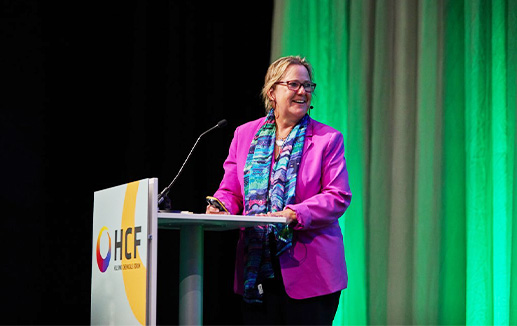
Speaking at the Helsinki Chemicals Forum yesterday, Kristin Schreiber (pictured), director for chemicals, bioeconomy and retail at DG GROW, said the debate over REACH should not be framed as a binary choice between a full legislative rewrite and the status quo. Schreiber argues that there are several other avenues to improve how the regulation works in practice.
A complete overhaul of the regulation, including its core text and annexes, would be a lengthy process, she said. More targeted changes can be made through the comitology process, but this route would allow policymakers to address only certain issues.
"If you want to tighten certain enforcement requirements, that is something you can only do through a re‑legislative procedure," Schreiber said. However, she added, enforcement issues could also be tackled horizontally through other legislation that applies more broadly, rather than by reopening REACH itself.
"For many issues, you can address both predictability and simplification without any formal change to the legislation," Schreiber said.
"We want to have a strong business case for innovative and sustainable chemistry in Europe, and we need to see how best we get to that objective."
This could include moving away from large numbers of individual REACH authorisations towards broader restrictions, which can be achieved under the existing legal framework, she said.
Concerns over the burden and effectiveness of the authorisation process have shaped recent policy choices, including the Commission’s decision to move chromium trioxide substances from authorisation to restriction.
Recently, the German government said it opposes any revision of REACH, including reopening the legal act or proposing selective amendments to the EU framework and its annexes.
‘Huge undertaking’
Ralf Schulz, head of corporate transformation strategy at Sika – a Swiss-based speciality chemicals company focused on construction chemicals – warned that a full revision of REACH would be a major undertaking likely to stretch well into the next EU legislative term following the 2029 elections.
That, he said, would mean years of regulatory uncertainty at a time when Europe’s chemicals industry is already under significant strain.
"The question that all stakeholders must ask themselves is whether this is really the time to go for it," Schulz said. "You might open a box with a completely uncertain outcome. For now, I think it is simply not the time to do it."
Schulz called instead for a sharper focus on enforcement, warning that compliance pressures would only grow as volumes of imported products rise. He said this trend could be exacerbated if production shifts increasingly to third countries.
Other priorities, he said, should include better implementation of existing rules and increased resourcing of authorities so they are able to carry out their duties effectively. Such changes could be delivered through amendments to REACH’s annexes.
"I am absolutely convinced that, at this point in time, it would fulfil many of the needs of industry, but also of other stakeholders, society and NGOs," he said.
If addressed incrementally, he added, those steps could ultimately bring the system closer to a full revision. The Commission could also use the time to prepare the ground for future policymaking, including by addressing scientific knowledge gaps.
No time to lose
Tatiana Santos, policy manager for chemicals and nanotechnology at NGO the European Environmental Bureau (EEB), agreed that REACH must keep pace with evolving science and acknowledged the pressures on EU competitiveness.
However, she said that broader planetary health challenges could not be ignored, and REACH must be strengthened without delay.
At the same time, Santos added, any revision would have to be undertaken with a clear mandate to improve protections. "If it’s not going to be about protection, then we cannot support this revision," she said.
Santos identified the Commission itself as the main bottleneck to regulatory action, arguing that years‑long delays in decision‑making were holding back progress. So long as a REACH revision remains uncertain, she called for faster progress on the restrictions roadmap.