



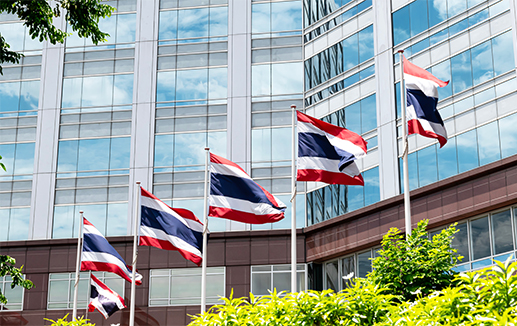
 © Ratchapon stock.adobe.com
Thailand’s Department of Industrial Works (DIW) is spearheading efforts to align its chemical and hazardous substances management framework, as part of the country’s drive to join the OECD.
The work, overseen by a national steering committee, is part of Thailand’s ambition to achieve full OECD membership by 2028.
"Thailand’s current efforts are less about replacing the existing Hazardous Substance Act (HSA) and more about gradually strengthening the overall framework toward a more structured, OECD-aligned system," says Piyatida Pukclai, regulatory policy manager for Asia-Pacific at Knoell.
In late 2024, Thailand reviewed its HSA, the primary regulatory framework, as the country transitions from a hazard-based model toward a risk-based approach.
However, the reforms are likely to introduce more structured data requirements, a stronger emphasis on hazard communication, and closer consistency with international data and testing standards, said Dr Pukclai.
She said the direction of travel is "quite clear" for industry, and while it may increase short-term compliance efforts, it should improve regulatory predictability and facilitate international alignment in the longer-term. She added that the developments remain a transition rather than an immediate regulatory shift.
Discussions on addressing regulatory gaps have focused on developing a more comprehensive chemicals inventory, the Thailand Existing Chemicals Inventory (TECI), as well as further convergence with updated GHS standards and improved data availability and transparency through systems such as OECD’s eChemPortal. She described these as "typical building blocks in OECD-style chemicals management".
The DIW is considering alignment with the seventh revised edition of the UN Globally Harmonized System of Classification and Labelling of Chemicals (GHS 7). However, some industry stakeholders have expressed a preference for moving directly to a newer version, such as GHS 8, which came as a surprise to authorities. Dr Pukclai believes this is a reflection of how some companies are already operating with more advanced global standards.
Regarding the country’s earlier attempts to develop a chemical act, she said it remains uncertain how and when a standalone chemical act may materialise. If progressed, it would likely consolidate and modernise the current fragmented framework rather than fully replace existing laws.
At a DIW seminar in Bangkok on 23 April, industry stakeholders discussed Thailand’s plans to upgrade chemical and hazardous substance management toward OECD standards.
United Analysts and Engineering (UAE) Consultant Co outlined the scope of work under the ongoing OECD Chemicals and Biotechnology Committee (CBC) review, which is assessing Thailand’s existing chemicals regulations. The DIW, Thai Industrial Standards Institute (TISI) and Department of Medical Sciences are participating in the review with the CBC.
Bangkok-based consultancy HS-Tech Engineering said the DIW is leading a 4 Urgent Missions project from April to October this year.
The initiative identifies four priorities for mandatory compliance and stricter enforcement: full GHS harmonisation and updates to newer revisions; development of a national chemical inventory and data integration; modernisation of chemical storage standards; and implementation of a Pollutant Release and Transfer Register (PRTR), similar to the US TSCA framework and Process Safety Management (PSM) systems.
The consultancy said reforms previously expected to take a decade are now being compressed into a 24-month window between 2026 and 2027.
Looking ahead, the consultants recommend that companies set aside resources in their 2027/28 budgets for safety data sheets (SDS) and label updates, as well as potential warehouse modifications. They also recommend that companies ensure their current storage practices are at least fully compliant with existing standards, which will form the baseline for more stringent inspections in the future.
OECD accession process under the CBC
Thailand’s application is undergoing technical assessment across 25 OECD committees, one of which is the CBC.
Under the OECD accession roadmap dated 10 July 2024, Thailand is expected to "give particular attention to hazard communication in the supply chain and to the establishment of a systematic and comprehensive industrial chemicals management system".
The roadmap calls for Thailand to agree, no later than the date of accession, to accept chemical test data generated under the OECD’s Mutual Acceptance of Data (MAD) system and in accordance with OECD Principles of Good Laboratory Practice (GLP) and test guidelines.
Thailand is also expected to harmonise its chemical safety policies with those of OECD countries, joining them to protect human health and the environment, adopt an OECD chemicals management system to contribute to a level-playing field, and increase opportunities for work-sharing with OECD partners.
The roadmap also expects Thailand to strengthen pollution prevention, control and remediation measures and take on obligations under OECD chemicals-safety instruments, and multilateral environmental agreements (MEAs) related to chemicals management.