



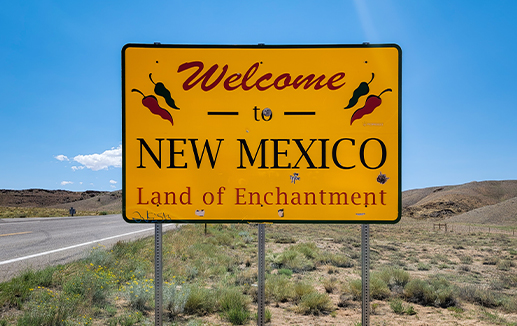
 © Aby stock.adobe.com
An Iowa-based paint manufacturer has filed an appeal challenging New Mexico’s final rule implementing its PFAS product restrictions, triggering judicial review of one of the most far-reaching US state-level regimes governing the persistent chemical class.
Filed on 22 May, the notice of appeal (NOA) by Diamond Vogel asks the New Mexico Court of Appeals to assess whether state regulators acted lawfully when adopting a rule to implement the PFAS Protection Act (HB 212). The case is likely to focus on controversial aspects of the rule, including labelling requirements that apply to most PFAS-containing products sold in the state from 2027.
Governor Michelle Lujan Grisham signed the PFAS Protection Act (HB 212) last year. The statute phases out intentionally added PFAS across several product categories beginning in 2027, before banning the chemicals from most goods by 2032, unless a use qualifies as "currently unavoidable".
New Mexico’s Environmental Improvement Board (EIB) adopted a rule in April to implement the law, setting out requirements for product labelling, reporting, testing, exemptions, fees and enforcement.
Product labelling concerns
Diamond Vogel’s NOA does not set out substantive legal arguments. Instead, the appellant will outline these in a docketing statement expected next month (see box).
However, Philip Moffat, founder of Verdant Law and counsel involved in the appeal, told Chemical Watch News & Insight that the company’s concerns centre on product labelling issues that first emerged during the rulemaking process.
From 1 January 2027, covered products must carry a label featuring an Erlenmeyer flask symbol indicating the presence of PFAS. Manufacturers must also submit detailed reports to the New Mexico Environment Department (NMED) on PFAS content in products sold in the state.
According to Moffat, Diamond Vogel is concerned about "the feasibility of compliance" with the 2027 deadline, as well as the scope of labelling requirements, which may apply to products otherwise exempt from HB 212.
For example, the law’s PFAS restrictions do not apply to paints and coatings until 2032, and fluoropolymers are also excluded.
"We feel pretty good that our concerns are legitimate and they deserve a proper vetting before the court," Moffat said.
New Mexico’s rule appeal process
Under New Mexico law, parties have a 30‑day window to challenge a final rule after it is filed with the state records office.
Once an appeal is lodged with the state Court of Appeals, the agency compiles the administrative record from the rulemaking process, which forms the basis for judicial review.
The appellant has 30 days to submit a docketing statement outlining legal arguments against aspects of the final rule.
The court will then establish a briefing schedule, and the case will proceed on the written record developed during rulemaking.
The rule remains in force during the appeal unless the appellant obtains a stay.
Attention will now turn to Diamond Vogel’s forthcoming docketing statement, expected in the coming weeks, which should provide the first detailed indication of the legal arguments underpinning the challenge.