



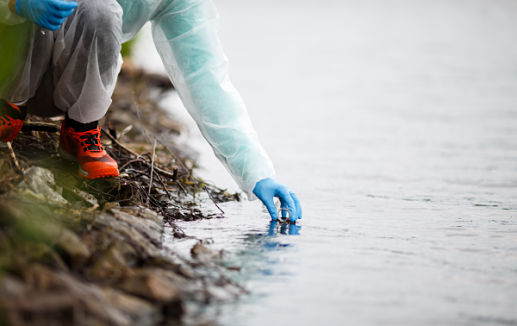
 © Sergey stock.adobe.com
Mixtures of bisphenols in the environment are up to 16 times more toxic than bisphenol A (BPA) alone, according to a German study for the European Partnership for the Assessment of Risks from Chemicals (PARC).
With BPA increasingly regulated, bisphenol substitutes are routinely found in human and environmental samples, and many also exhibit oestrogenic activity. Germany withdrew its proposed group restriction of bisphenols under REACH in 2023, and ECHA expects an updated restriction dossier by March 2027.
"We now have a new problem, which is that they [bisphenols] are occurring in mixtures with BPA," said Vanessa Srebny from the Helmholtz Centre for Environmental Research (UFZ). It is important to assess the compounds together because assessing them individually underestimates their risk, she told the Society of Environmental Toxicology and Chemistry (SETAC) annual meeting in Maastricht on 18 May.
To communicate the complex topic of mixture effects "more effectively" to regulators, the team compared toxicity with that of BPA, creating equivalent concentrations (BPA-EQ) for different bisphenols.
Surface water bisphenols
The researchers created seven mixtures of up to ten bisphenols based on concentrations detected in European surface waters. They tested the mixtures using in vitro bioassays, including tests for oestrogen receptor activation, mitochondrial toxicity and cytotoxicity. A range of exposure levels provided dose-response curves and effect concentrations.
The experimental results for the seven mixtures agreed well with predictions from concentration-additive toxicity models.
The researchers calculated BPA-EQs by comparing the toxicity of each mixture component with that of BPA, multiplying each by its concentration, and summing the results to obtain a single value.
The team applied their approach to a surface water exposure scenario with six bisphenols:
- BPA;
- 4,4′-(1,1,1,3,3,3-hexafluoropropane-2,2-diyl)diphenol (BPAF);
- 4,4′-(butane-2,2-diyl)diphenol (BPB);
- 4,4′-ethylidenbisphenol (BPE);
- bis(4-hydroxyphenyl)methane (BPF); and
- 4,4′-sulfonyldiphenol (BPS).
Based on results from three bioassays, the surface water mixture was up to 16 times more toxic than BPA alone at the same concentration. The mixture effects exceeded the EU’s environmental quality standard (EQS) for BPA for surface water used for abstracting drinking water.
The in vitro assays showed that the main contributors to mixture effects were BPAF, which is more potent than BPA, and BPB, which has been detected in higher concentrations, Srebny said.
The EQ approach could also be used for foods or human biomonitoring data or for other groups of substitute chemicals with similar modes of action, such as PFAS and phthalates, Srebny said.
The team, led by Beate Escher at UFZ, has published the study results in the journal Environmental Science: Processes & Impacts.
"Meaningful risk reduction can only be achieved if alternatives are less potent than BPA, ideally inactive, and do not introduce additional toxicological endpoints," the article concluded. The use of BPA and its alternatives should be limited to essential applications to minimise both environmental burden and human exposure, it said.