


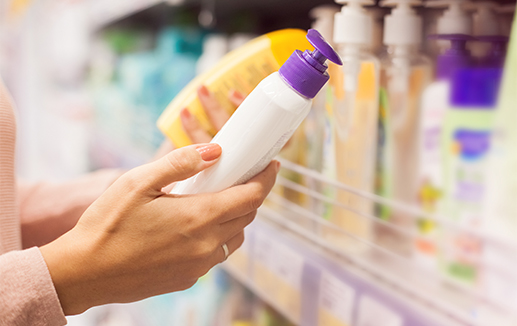
 © Stanislaw Mikulski stock.adobe.com
The US Food and Drug Administration (FDA) has finalised an order adding the UV filter bemotrizinol (BEMT) to its list of permitted sunscreen active ingredients, the first such approval in more than 25 years.
With the approval, BEMT becomes the first UV filter since the 1990s cleared to enter the US market without a new drug application (NDA). It is also the first active ingredient added to the over-the-counter (OTC) sunscreen monograph under the revised process established by the 2020 Coronavirus Aid, Relief and Economic Security (CARES) Act.
The addition of BEMT to the list of approved ingredients is "a significant milestone in the agency’s efforts to advance sunscreen innovation", the FDA said in a 9 June statement announcing the approval.
A spokesperson for DSM-Firmenich (DSM), the company that sought approval for BEMT, called the approval "a watershed moment for public health in the US".
The final order (OTC 000039) "marks long-awaited progress in photo-protection", Carl D’Ruiz, senior manager for North America beauty and care advocacy for DSM, told Chemical Watch News & Insight.
The order will formally designate BEMT as generally recognised as safe and effective (GRASE) for adults and children six months and older. It will allow the use of BEMT in sunscreens up to a concentration of 6%, equal to the level put forward in the agency’s proposed order issued late last year.
Cautious welcome from NGOs, industry
The NGO Environmental Working Group (EWG) called the approval of BEMT a "major win for US consumers".
"For decades, Americans have used outdated sunscreen tech while the rest of the world moved forward," EWG chief science officer David Andrews said. "The approval of bemotrizinol will help change that. The FDA’s go-ahead will finally bring more effective, safer sun protection to American store shelves."
At the same time, the group said the 20-year timeframe it took to approve BEMT is "a reminder of how far the US regulatory system still has to go" (see box).
Sunscreen formulators in the US have access to 16 approved UV filters, while European formulators have access to about 30, EWG said.
Melanie Benesh, EWG’s vice president for government affairs, cheered the approval, but said it also "shines a harsh spotlight on a federal system stuck in neutral". She said both companies and Congress must do more, with binding deadlines for chemical testing and authority to pull noncompliant and unsafe products from US shelves.
The Personal Care Products Council (PCPC) applauded the FDA’s decision to add BEMT to the sunscreen active ingredient list. But the trade group also called for more action to streamline the approval process.
"While we commend FDA for this progress, continued efforts are needed to establish a more efficient and modern approach for approving additional sunscreen active ingredients," the PCPC said.
Long road to approval
According to the FDA, BEMT protects against both ultraviolet A and B rays and has relatively low levels of absorption through the skin. The EU approved its use in sunscreens in 2000.
DSM submitted BEMT for assessment in the US in 2005 under the FDA’s ‘time and extent application’ (TEA) process, a much-maligned framework for approving sunscreen active ingredients that called for stringent and expensive testing that often led industry to abandon efforts to commercialise new substances in the US.
The US Congress reformed the FDA’s ingredient approval process under provisions included in the 2020 CARES Act.
Despite the changes, the approval process remained slower than expected, and DSM had to reformat some of its data to fit the new OTC drug monograph order request (OMOR) process created under the CARES Act.
The continued delays have spurred Congress to weigh in on the issue again, including language in a 2025 spending bill directing the FDA to consider "real-world evidence" and non-animal test methods when determining whether ingredients are GRASE.
With this week’s approval, however, D’Ruiz said DSM is "very excited".
The order is set to take effect on 9 August, 60 days after its publication in the Federal Register. At that point, DSM can begin marketing the substance, D'Ruiz said. In the interim, the company plans to complete an FDA drug listing and obtain a national drug code (NDC).
Based on these steps, the company expects BEMT products, marketed under the tradename PARSOL Shield, to reach US store shelves in the final quarter of 2026, he said.
"This has been a rigorous process, and while there are always insights along the way, we see this primarily as an important step forward," D’Ruiz said. "We look forward to continuing the dialogue, as innovation in OTC sunscreen – and progress in skin cancer prevention – must continue."