



 © ChemSec
EU environment commissioner Jessika Roswall has reprised a suggestion to split the upcoming PFAS restriction between consumer and industrial uses, a proposal backed by powerful industry groups but strongly opposed by NGOs.
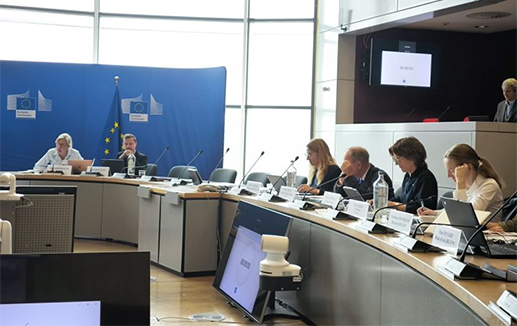
Her remarks, made during a high-level dialogue on 15 June attended by more than 20 stakeholder representatives (pictured), signal the European Commission’s continued inclination to narrow the initial scope of the wide‑ranging restriction, allowing continued use of PFAS in critical industrial applications where alternatives are not yet available.
Roswall and industry commissioner Stéphane Séjourné have previously signalled support for such a split, a position also backed by the German chemicals industry association VCI. However, NGOs and scientists have said that only a universal restriction covering all uses can effectively address PFAS risks.
PFAS expert Ian Cousins of Stockholm University told the meeting that separating PFAS uses would be problematic for several reasons.
"First, the boundary is impossible to define cleanly, and any attempt to do so creates loopholes rather than clarity," he said. "Second, consumer uses are also not where the main problem lies. In some countries, PFAS‑containing consumer products have already disappeared from mainstream retail. Regulating this space is politically easy, but it delivers limited environmental benefit because the transition has happened or is ongoing."
Industrial uses are responsible for the vast majority of PFAS releases, he said, adding that allowing broad industrial exemptions would "fix the optics, not the emissions".
NGOs, including the European Environmental Bureau (EEB) and ChemSec, strongly oppose a two-tier approach, arguing that the EU can overcome the challenges of replacing PFAS with safer alternatives.
The Commission said in a statement after the meeting that it would consider a ban on PFAS in consumer goods, whereas for industrial applications, "continued use may be permitted for critical uses where adequate alternatives are not yet available, but only under strict conditions and until acceptable substitutes have been developed".
The meeting is part of the Commission’s Chemicals Industry Action Plan, which brought together a broad range of stakeholders, including PFAS producers and users, as well as developers of alternatives.
It comes after ECHA’s consultation on the socio-economic impacts of the restriction received more than 3,500 responses, primarily from industry stakeholders. The final opinion of the agency’s Committee for Socio-Economic Analysis (SEAC), due by the end of the year, will mark a decisive step in the EU’s years-long effort to restrict PFAS.
Broad support
Overall, meeting delegates broadly supported the restriction proposal, several participants told Chemical Watch News & Insight.
For the heating and cooling sector, ATMO, a producer of natural refrigerants, said alternatives are already available and called for early bans on PFAS in refrigeration with minimal derogations. It also stressed the need to mobilise both private and public investment.
The electric vehicle sector also called for strong PFAS restrictions, saying this will steer investments towards alternatives.
The fluoropolymer industry, however, reiterated its strong opposition to a universal restriction and called for a full exemption of fluoropolymers, subject to strict emission controls.
Caroline Andersson, director of Fluoropolymers Product Group (FPG) – part of Plastics Europe – said this would safeguard the strategic sectors Europe depends on while ensuring responsible manufacturing, use and disposal.
Andersson also told Chemical Watch News & Insight that the available evidence does not support claims that alternatives are readily available.
The group recently published a study examining alternatives in automotive and semiconductor manufacturing applications. It found that when assessed against the required technical criteria, no viable substitutes for fluoropolymers are currently available for these applications in the short- to medium-term.
Separately, Chemours told Chemical Watch News & Insight that a rapid adoption of the PFAS restriction would be detrimental to Europe’s economy. It said its Teflon fluoropolymers are used in many critical industrial applications, with no viable alternatives and that they are safe for their intended use.
Calls for a split restriction have also come from other stakeholders. A ceramic cookware manufacturer said this approach would enable a rapid phase-out of PFAS in consumer products, while the European Federation of Pharmaceutical Industries and Associations backed a differentiated approach.
Stakeholder views on PFAS use in electronics were divided. DigitalEurope noted that PFAS are still present in certain components of electronic goods, whereas ChemSec said companies in its network have already achieved full substitution in electronics.
This article was corrected on 25 June to remove a paragraph containing an erroneous reference to Teflon and to add comments from Chemours.