



 © European Union
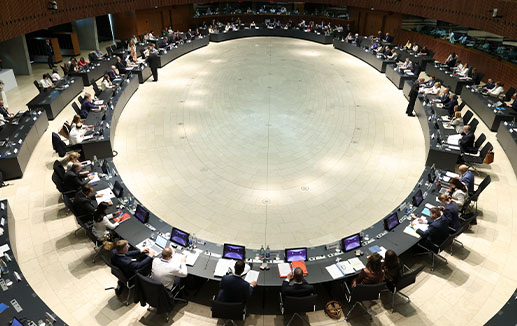
EU environment ministers have placed enforcement gaps and digitalisation at the heart of efforts to modernise the bloc’s REACH regulation, warning that weak controls on imports and online sales risk undermining both safety standards and industrial competitiveness.
Their views, expressed during a 25 June meeting of the EU’s Environment Council, add to the growing pressure on the European Commission to tighten controls around import compliance and online sales, and push industry to improve supply chain data.
Even without a full REACH reopening, businesses may face tougher scrutiny, more digital reporting expectations and faster-moving restrictions on substances of concern.
At the meeting, several countries pointed to persistent non-compliance among imported substances as a priority issue.
Romania cited findings that "a third of imported substances […] are not registered, and 16% are in breach" of EU rules, describing this as both a health risk and "serious unfair competition".
France echoed concerns about market distortions, warning that "we cannot let products enter the market that are not compliant and dangerous […] We need a level playing field".
A rising number of delegations also highlighted e-commerce as a particular challenge for enforcement.
Denmark called on the Commission to stop illegal products entering the EU through online platforms, while Estonia said online sales are driving "growing enforcement challenges" linked to non-compliant imports.
A common thread among ministers is the need to boost coordination between customs, market surveillance and chemicals authorities, alongside greater accountability for online platforms handling cross-border sales.
Some member states also suggested exploring a dedicated REACH enforcement instrument, while others backed building on existing tools, such as customs reforms and broader product safety legislation.
Digitilisation
Alongside enforcement, digitalisation emerged as a central policy lever. Member states broadly endorsed moves to harmonise and digitise safety data sheets (SDSs) and enhance data-sharing infrastructure across the supply chain.
Latvia said digital tools can improve access to information and "reduce administrative burden", while the Netherlands highlighted gains from more modernised systems to "improve information exchange".
Ministers also pointed to the role of digital tools in enabling more targeted inspections and risk-based controls, seen as essential to making enforcement more effective without increasing regulatory complexity.
PFAS
A second major focus of the discussion was the treatment of substances of concern, particularly PFAS, which the Commission has identified as a top priority.
Sweden underlined the need to strengthen identification of problematic substances, including endocrine disruptors, while the Netherlands described the upcoming PFAS restriction as one of the most important files under REACH.
Speaking at the meeting, the Commission confirmed that ECHA is currently assessing the PFAS restriction dossier, with work expected to conclude by the end of the year, before a proposal is brought forward.
The council meeting discussions point to a policy direction focused on closing compliance gaps, accelerating digital tools and advancing restrictions on high-profile substances, rather than pursuing major legislative change.
Debate over whether to fully reopen the REACH regulation nevertheless lingered at the meeting. While some countries, including Luxembourg, said a revision is a "key lever" to strengthen ambition, many others stressed the need to avoid regulatory disruption.
Germany warned that reopening the law "would lead to uncertainty and not produce benefits", instead calling for improvements within the existing framework.
The tensions reflect a wider split over how to reinforce REACH implementation. NGO the European Environmental Bureau (EEB) warned that industry-backed simplification proposals risk slowing action and weakening safeguards, while industry association Cefic has said the changes would streamline processes and elevate enforcement efficiency.
For companies, the immediate signal is that compliance pressure – especially on imports – and expectations around digital data management are set to intensify in the near term.