



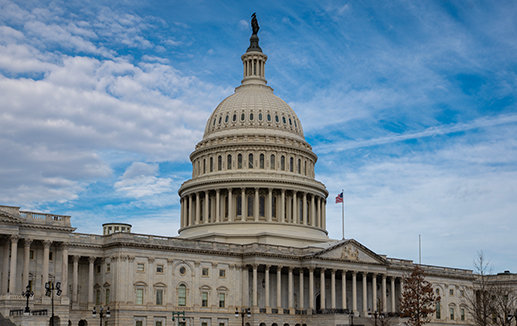
 © Volodymyr stock.adobe.com
President Donald Trump has signed legislation extending the US EPA's authority to collect TSCA fees until 11 December, as part of a continuing resolution (CR) that will keep federal agencies funded through the midterm elections.
The CR, passed by Congress on 1 September, gives lawmakers more time to consider industry-backed amendments to TSCA that have been under discussion in both chambers this year.
The resolution's adoption also removes the immediate threat of another government shutdown, after funding impasses forced partial closures of the federal government last year.
Under the legislation (HR 6500), funding for federal agencies remains at current fiscal year (FY) 2026 levels through 11 December, preserving the EPA's $8.816bn budget and the Food and Drug Administration's (FDA) nearly $7bn in funding.
The Senate passed the measure 90-6 in August, and the House agreed to the Senate amendments on 1 September. President Trump signed it into law on 2 September.
The CR includes an extension of the EPA's authority to collect TSCA fees until 11 December, allowing the agency to continue collecting industry fees for actions such as filing a TSCA pre-manufacture notice (PMN).
Without Congress's recent action, the EPA's fee collection authority would have expired on 30 September, ten years after lawmakers first authorised the agency to collect such fees.
TSCA amendments
Industry groups this year have used the looming expiration of that fee authority as a lever to press for broader legislative changes to TSCA.
Both the House and Senate released discussion drafts of potential amendments earlier this year, though neither measure has cleared congressional committees.
Environmental and public health groups have opposed the amendment effort, arguing that the draft bills put forward in both chambers would weaken chemical safety protections, while congressional Democrats have resisted using the fee reauthorisation as a bargaining chip for broader reforms.
With the fee authority extension, those debates will now continue into the 'lame duck' session of Congress, which runs from the 3 November midterm elections to the swearing in of newly elected officials on 3 January.
‘Breathing room’ for negotiations
The American Chemistry Council (ACC) said extending the EPA's TSCA fee authority "will keep the programme running without disruption, while giving Congress and stakeholders time to work through practical improvements to TSCA implementation".
David Fischer, a partner at Keller and Heckman who served as deputy assistant administrator for the EPA's chemicals office during the first Trump administration, said the extended fee authority "gives Congress some breathing room to seek reform".
Even so, Fischer said that "time is running out" for more comprehensive changes to the law.
Any legislative amendments, he said, may be limited to TSCA section 5, which governs pre-market reviews of new chemicals. The new chemicals programme has remained a source of sustained industry frustration since the 2016 Lautenberg amendments overhauled the law.
Chris Phalen, vice president of domestic policy at the National Association of Manufacturers (NAM), struck a more optimistic tone about advancing broader amendments.
Inclusion of the TSCA fee extension in the CR is "a strong sign of continued bipartisan interest in delivering long-term programme funding certainty with targeted, common-sense reforms" to both the new and existing chemicals programmes, he said.
Leaders of the Senate Committee on Environment and Public Works (EPW) and the House Energy and Commerce (E&C) Committee should hold legislative mark-ups "as soon as possible so Congress can deliver an important manufacturing win later this year", Phalen said.