



 © railwayfx and mewaji stock.adobe.com
China is increasingly active in discussions on the Globally Harmonized System of Classification and Labelling of Chemicals (GHS), signalling a stronger influence on international standard-setting, analysis of UN meeting minutes by Chemical Watch News & Insight suggests.
A more active China in GHS discussions could affect the direction, pace and technical emphasis of future revisions, with knock-on implications for regulators translating the system into domestic law and businesses managing labels, safety data sheets (SDSs), product stewardship and market access across multiple jurisdictions.
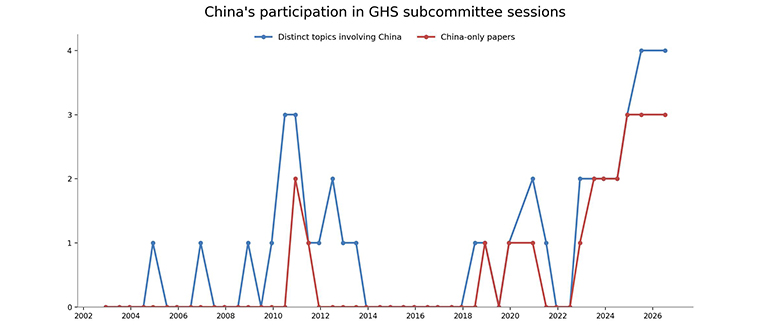
China’s involvement in meetings of the GHS subcommittee, which the UN created in 2001 to steer the system’s development, spiked between 2010 and 2012, including two meetings in which China was involved in three distinct topics. The spike roughly coincided with GHS implementation in the jurisdiction via Decree 591 and other legislation.
Either side of that period, however, China was relatively passive until around 2022.
The country initially had observer status but gained full membership ahead of the fourth meeting, in December 2002. In roughly half of the 46 meetings since, it was not involved in any meeting topics, the minutes show.
Since 2022, however, China’s involvement has been on an upward trajectory (see chart).
 © Chemical Watch News & Insight
It was involved in four topics at each of the two most recent meetings, representing a new maximum. Those two meetings were preceded by the December 2024 meeting, at which China was involved in three topics, and four meetings from December 2022 to July 2024, at which it was involved in two.
In contrast, China was not involved in any topics for eight meetings in a row between 2013 and 2017.
A similar trend applies for the number of papers authored solely by China – which hit a new maximum of three for each of the most recent three meetings.
Wider leadership role
The recent growth in China’s GHS involvement mirrors a broader trend identified by various researchers, who say China has evolved from primarily an adopter of international rules and standards to a more active participant in the design of criteria.
In a 2025 paper for the World Development Report, John Jiong Gong, professor of economics at Beijing’s University of International Business and Economics, and Vanessa Yanhua Zhang, executive vice president and head of Greater China at Compass Lexecon, described the country as "an increasingly prominent player in international standard-setting".
The researchers describe three distinct phases.
Between 1978 and 2000, China was focused on adopting international standards. From 2001, the focus shifted to catching up with foreign standard-setters, until 2015, when China began to establish itself as a leader in global standardisation.
Asked about the Chemical Watch News & Insight findings, Professor Gong said he was "not surprised" to see China participating more. "As Corporate China expands more overseas, one would naturally expect such a phenomenon," he said. "A standard, after all, cannot exist in a vacuum; there are products, services and businesses behind it."
Topics of interest
Topics in which China has recently been involved at subcommittee meetings include:
- endocrine disruption (2023);
- substances and mixtures that form flammable vapour-air or gas-air mixtures (2023, 2024, 2026);
- the categorisation of flammable solids other than metal powders (2024, 2025);
- revision of the Manual of Tests and Criteria (2024, 2025, 2026);
- the definition of an article in the scope of the system (2025, 2026); and
- sternum sampling for in vivo somatic cell mutagenicity testing (2026).
The next GHS subcommittee meeting is scheduled for 2-4 December.