



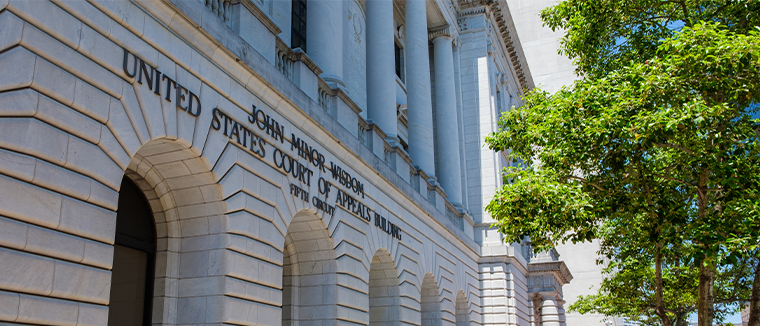
 © William A. Morgan stock.adobe.com
The Fifth Circuit's recent decision striking down the EPA's methylene chloride rule will send shock waves through the TSCA programme for years to come, according to legal and policy experts.
The 15 September ruling reaches well beyond a single solvent and puts every risk evaluation and risk management rule the agency has finalised since 2016 on an uncertain legal footing. At the same time, it leaves a great deal of uncertainty around the future trajectory of the nation's chemicals management law, particularly for the TSCA section 6 existing chemicals programme.
"This is the most important TSCA decision on section 6 since 2016 and should have significant ripple effects," says David Fischer, a partner at Keller and Heckman and former deputy assistant administrator for the EPA's Office of Chemical Safety and Pollution Prevention (OCSPP).
It remains to be seen how the decision could influence Congress as lawmakers debate whether to substantively amend TSCA, and what the potential impacts could be for ongoing litigation over other TSCA rules.
This is the most important TSCA decision on section 6 since 2016 and should have significant ripple effects
David Fischer, partner, Keller and Heckman
Some commentators also speculated that the decision could reshape how the EPA reviews new chemicals before they reach the market, given the Fifth Circuit's new interpretation as to how the EPA should determine 'unreasonable risk' under the law.
The bottom line, according to Camille Heyboer, a senior attorney at Arnold & Porter, is that "we are likely years away from having certainty on the TSCA section 6 risk management measures applicable to chemicals in the section 6 pipeline".
Everything called into question
In the case of East Fork Enterprises et al v EPA, a three-judge panel of the US Court of Appeals for the Fifth Circuit unanimously ruled to vacate the agency's 2024 TSCA section 6(a) rule for methylene chloride and the underlying risk determination.
The 44-page decision took aim at two core elements of the Biden administration's approach to conducting risk evaluations, invalidating the ‘whole-chemical’ risk determination approach and rejecting the default assumption that workers do not wear personal protective equipment (PPE). The court also criticised the exposure limits the agency derived and faulted the near-total prohibition on the solvent's uses.
According to two EPA veterans – Ryan Schmit and Richard Engler, now with Bergeson & Campbell – the Fifth Circuit in East Fork "did not mince words" as it addressed a range of statutory questions that regulated parties, environmental groups and successive presidential administrations have contested for years without resolution.
Schmit and Dr Engler say the ruling is more consequential than other appellate court decisions issued since the 2016 Lautenberg amendments, including the Ninth Circuit’s 2019 Safer Chemicals, Healthy Families v EPA concerning the agency’s initial risk evaluation framework rule and the Fifth Circuit’s 2024 decision to cancel TSCA PFAS orders in Inhance Technologies v EPA.
[The ruling] sides with the chemical industry at the expense of public health and will put more consumers, workers and the public at large at risk of serious harm
Liz Hitchcock, director of federal policy, Toxic-Free Future
Instead, Schmit and Dr Engler liken the East Fork ruling to the Fifth Circuit's pivotal 1991 decision in Corrosion Proof Fittings v EPA, which struck down the EPA's TSCA asbestos ban and effectively paralysed the existing chemicals programme for a generation. The East Fork decision, they say, is "Corrosion Proof Fittings on steroids".
Meanwhile, Liz Hitchcock, director of federal policy at Toxic-Free Future (TFF), says the Fifth Circuit's ruling reflects a "terrible decision on one of the most dangerous chemicals in commerce". The ruling, she says, "sides with the chemical industry at the expense of public health and will put more consumers, workers and the public at large at risk of serious harm".
Rework of existing evaluations, rules
While the Fifth Circuit's ruling only directly applies to the TSCA evaluation and risk management rule for methylene chloride, the legal basis underpinning the decision calls into question more than a dozen risk evaluations developed under the same approach, as well as four other final risk management rules based on similarly developed evaluations.
Lauren Gates, counsel at Keller and Heckman and former senior lawyer within the EPA's Office of General Counsel, says the breadth of the ruling "calls into question every action EPA has taken over the last six years".
Fischer offers a similar view, saying the EPA should respond to East Fork by revisiting "every risk evaluation and risk management rule finalised to date".
That would involve pulling back rules for trichloroethylene (TCE), perchloroethylene (PCE), carbon tetrachloride (CTC) and asbestos – all of which are the subject of lawsuits of their own.
Fellow Keller and Heckman partner Herb Estreicher says the EPA should not only revisit the existing rules but announce that it will not enforce any of them while reconsideration plays out.
How the EPA might respond to completed rules is only half of the puzzle, however, as it must also determine the path ahead for chemicals still under review or in line for risk management actions.
Can these rules be finalised as proposed, or do the risk evaluations have to be redone?
Martha Marrapese, partner, Wiley
According to Martha Marrapese, a partner at Wiley, the most pressing near-term question is what East Fork means for proposed rules that were built on risk evaluations with whole-chemical determinations, such as for the solvents NMP or 1-BP. "Can these rules be finalised as proposed, or do the risk evaluations have to be redone?" she asks.
Heyboer says the EPA faces a "monumental task" in figuring out a path forward, made harder by the fact that many of the people who originally worked on the risk evaluations and rules may no longer be with the agency.
Framework rule considerations
The ruling arrives as the EPA is already working to revise a Biden-era version of the TSCA risk evaluation framework rule, a procedural regulation that ties directly to the issues at play in East Fork.
The existing rule, adopted in the final months of the Biden administration, requires the EPA to follow the whole-chemical approach and the no-PPE assumption that the Fifth Circuit has now rejected as unlawful.
This ruling will help the agency have more legal support to rely on as the rule moves forward, and there is now more of an incentive for the agency to finalise it quickly
Lauren Gates, counsel, Keller and Heckman
Gates says the court's decision should accelerate the EPA's push to finalise the updated framework rule, which, as proposed in September 2025, would require the agency to make use-by-use risk determinations and factor in PPE where evidence supports it.
"This ruling will help the agency have more legal support to rely on as the rule moves forward, and there is now more of an incentive for the agency to finalise it quickly," she says.
Schmit and Dr Engler agree that the ruling lends support to the agency's planned changes, but they are less certain whether the decision would speed or slow the rulemaking process.
The EPA, they say, will likely need more time to consider whether the court's direction requires further adjustments to the risk evaluation framework rule beyond what is already on the table. If the EPA decides more significant changes are needed, they say, the agency will need to weigh whether a supplemental proposed rule is appropriate – a step that could significantly slow the path towards completing the rule.
Whatever pace the EPA sets, further litigation over the framework rule is a near certainty.
Dr Estreicher expects environmental NGOs to mount an immediate challenge, potentially in the Ninth Circuit, once the framework rule update is finalised. And if that litigation does come to fruition, there is likely to be a new presidential administration in place.
A new ‘unreasonable risk’ standard
As the EPA wrestles with policy choices for its risk evaluations, it must also contend with the determination in East Fork that TSCA is not a "zero-risk statute" and what that means for how the agency determines what constitutes 'unreasonable risk'.
Schmit and Dr Engler say the court's decision means the EPA's calculus of what constitutes 'unreasonable' risk will now have to be "described and supported based on application of the statutory factors", with greater emphasis on uncertainties and on conflicting evidence in the record.
According to Gates, stakeholders should "expect to see more record support and movement away from estimates driving risk determinations".
The court made very clear that EPA must also take into account negative studies, those that show no effect
Caffey Norman, attorney, Norman Law & Policy
Caffey Norman, an attorney at Norman Law & Policy who represented industry petitioners in the case, says the ruling could drive the EPA away from what he describes as a long-standing practice of focusing only on studies that report an effect.
"The court made very clear that EPA must also take into account negative studies, those that show no effect," he says. That "puts teeth" into TSCA's requirement for the agency to make decisions based on the 'weight of the scientific evidence'.
The American Chemistry Council (ACC), one of the industry groups that challenged the methylene chloride rule, says the East Fork ruling "reinforces that TSCA decisions must be grounded in science, evidence and real-world conditions".
Dr Estreicher says the court backs science positions that industry has argued for years, including the notion that "cascading uncertainty factors lead to nonsensical results and that the absence of adverse findings in human studies is very significant even in the face of contrary animal data".
By contrast, Maria Doa, senior director of chemicals policy at the Environmental Defense Fund (EDF) and a 30-year EPA veteran, says the court's ruling reflects a misunderstanding of standard toxicological practice.
Based on the court's logic, a level of exposure to a toxic chemical that is fine for a rat is fine for a baby
Maria Doa, senior director of chemicals policy, Environmental Defense Fund
The court "cherry-picks evidence, garbles its analysis, and reflects limited knowledge on both weight-of-evidence and the use of epidemiological studies", Dr Doa says.
"The use of uncertainty factors is not a means to get to zero risk," she says. "Based on the court's logic, a level of exposure to a toxic chemical that is fine for a rat is fine for a baby."
Open questions
The Fifth Circuit was clear that "unreasonable risk" under TSCA does not mean "zero risk" or authorise a "precautionary principle" approach.
But it did not clarify what the term should mean.
Gates says: "While the Fifth Circuit helpfully put some context into what is and is not unreasonable risk, it still failed to provide a definition."
Fischer says the ruling addresses, but does not answer, whether the current one-in-a-million cancer risk value constitutes unreasonable risk. "The court seems to imply that the answer to this question is no," he says, but there is no clear direction.
He also flags an unresolved question over the scope of risk evaluations: whether EPA can choose which conditions of use (COU) and exposure scenarios to include. Fischer notes that there is a footnote in the decision in which the court left open whether it agrees with the Ninth Circuit's reading in Safer Chemicals that the EPA lacks discretion to determine the scope of a risk evaluation, a question the court said it would leave "for another day".
Meanwhile, Dr Doa questions whether the parameters set out in the Fifth Circuit decision would result in legally defensible reviews.
"It would not be scientifically credible for EPA to use the court's incorrect approach," she says. "It does not reflect the use of the best available science, which is required by TSCA, and should not be used as guidance on how to conduct scientifically valid risk evaluations."
Higher bar for risk management
Moving beyond risk evaluations, the East Fork decision will also require the EPA to rethink its risk management approach to ensure that its regulatory actions address unreasonable risk 'to the extent necessary' – "no more, no less", as the court said, citing a separate decision.
That constraint is likely to produce more restrained risk management approaches going forward, Schmit and Dr Engler say. The court, they note, reaffirmed an "exceptionally high burden" for the EPA to support a chemical prohibition, which may push the agency towards using the full suite of regulatory tools available under section 6(a). Other available risk management options include warnings, concentration limits and monitoring.
The decision could also mean greater use of TSCA section 9 and greater deference to OSHA standards, or referring risks to other federal agencies to manage, Schmit and Dr Engler say.
According to Norman, the court's limits would result in fewer chemicals facing prohibitions under TSCA section 6(a) rules. "EPA cannot just eliminate important commercial chemicals from the chemistry set," he says.
Moreover, the agency must take seriously comments explaining that no feasible alternatives exist for many conditions of use, better account for the economic consequences of restrictions, and weigh the higher costs and lower productivity of available substitutes, he says.
EPA now has to take another run at imposing risk management measures 'to the extent necessary', without certainty that the measures they adopt would satisfy the Fifth Circuit or any other court in which these measures may be challenged
Camille Heyboer, senior attorney, Arnold & Porter
But Heyboer cautions that the court's direction on risk management leaves the EPA without certainty on where to draw the line.
While the Fifth Circuit found that the near-total prohibition on methylene chloride went beyond what TSCA allows, it did not specify what risk management measures would have satisfied the standard to regulate ‘to the extent necessary’, beyond the possibility of approving or revising OSHA standards.
"EPA now has to take another run at imposing risk management measures 'to the extent necessary'," Heyboer says, "without certainty that the measures they adopt would satisfy the Fifth Circuit or any other court in which these measures may be challenged."
New chemicals question
Several experts say the Fifth Circuit's interpretation of 'unreasonable risk' could spill into TSCA section 5 and bring potential changes to new chemical reviews.
Heyboer says the term 'unreasonable risk' appears in identical or near-identical contexts in sections 5 and 6, and "there is no clear basis for interpreting it differently for new chemicals versus existing chemicals".
For any change to take effect, she says, the onus would fall on companies submitting new chemical notices to identify where the agency's review may not be consistent with the court's interpretations and request that it modify its approach accordingly.
Fischer says the impacts on the new chemicals programme could be profound. The EPA, he argues, cannot simply rely on an "effect" but must identify what constitutes an "adverse effect", and must not only identify risk but clearly establish what is "unreasonable" about it and why.
However, Dr Estreicher doubts the ruling will have any practical impact on section 5 decision-making, noting that there is limited opportunity to apply judicial scrutiny to pre-manufacture notice (PMN) reviews.
TSCA section 5(e) consent orders govern most new chemical approvals, and in signing them, companies waive their right to appeal, Dr Estreicher notes. Without a lawsuit directing the EPA to adapt its practices, he says the Fifth Circuit's reasoning has little practical pathway into section 5.
The litigation landscape
Hanging large over these many questions is whether the Fifth Circuit's ruling in East Fork will remain the only consequential TSCA section 6 decision, or if other rulings could complicate the picture and ultimately tee up a Supreme Court fight.
The most immediate test will likely come from within the Fifth Circuit itself. A challenge to the EPA's asbestos risk management rule is pending before the same court that decided East Fork, and according to Schmit and Dr Engler, it will give the court an opportunity to amplify or expand on its TSCA views.
Also in play is the Third Circuit’s review of another TSCA rule, covering the solvent TCE, which raises issues that speak directly to the East Fork decision.
According to Norman, who represents industry petitioners in the case, the EPA's risk evaluation for TCE was driven by an unreproducible rat study showing cardiac anomalies, while giving insufficient weight to three studies that did not show the same effect even when their authors tried to reproduce it. Under the reasoning from the Fifth Circuit's decision, the "EPA's reliance on that study clearly would not be allowed", he says.
The composition of the Third Circuit panel could be a key variable, according to Dr Estreicher.
The Fifth Circuit panels in both Corrosion Proof Fittings and East Fork were composed entirely of judges from the court's more textualist administrative law tradition, he says. The Third Circuit panel selected to hear oral arguments for TCE is unknown, and if it proves more liberal, he says, "we may get a split between the circuits" that could set up a Supreme Court challenge to resolve any clash.
With that said, Dr Estreicher believes the Fifth Circuit's rejection of a "ban first and ask questions later" approach will ultimately be endorsed by other courts.
Congress and TSCA reform
The East Fork decision arrives as Congress is already engaged in a live debate over whether it should amend TSCA, with industry pressing for changes to be attached to legislation reauthorising the agency's fee collection authority before it expires on 11 December.
Schmit and Dr Engler say the ruling shifts the political calculus in ways that cut in multiple directions.
Lawmakers who were previously content with the status quo may now be more willing to engage in legislative conversations, while those who have been championing TSCA reform may feel the Fifth Circuit has already delivered the win they were seeking, reducing their appetite for a legislative fight.
But significant questions remain about what Congress can accomplish, particularly in a midterm election year.
According to Fischer, the chance of TSCA reform this year is "essentially zero". After the midterm elections in November, he anticipates Congress will focus on other pressing matters before turning to TSCA.
Dr Estreicher says any meaningful TSCA changes will probably need to wait for the next presidential administration, which will not be decided until late 2028. Industry's decision on whether to advocate for or resist TSCA amendments will likely turn on which party prevails in that election, he says.
Gates, meanwhile, says the ruling sends a clear signal that Congress should act. The current statutory structure for risk evaluations is "unworkable", she argues. While it may be too late for this legislative session, she sees bipartisan consensus for some degree of reform.
This is a question of implementation and industry litigation, not of legislation
Liz Hitchcock, director of federal policy, Toxic-Free Future
Hitchcock at Toxic-Free Future rejects the idea that Congress needs to revise the law.
"This is a question of implementation and industry litigation, not of legislation," she says, adding Congress does not need to amend the law. Instead, lawmakers should focus on ensuring the EPA has adequate resources to meet the obligations and authorities the 2016 amendments conferred.