



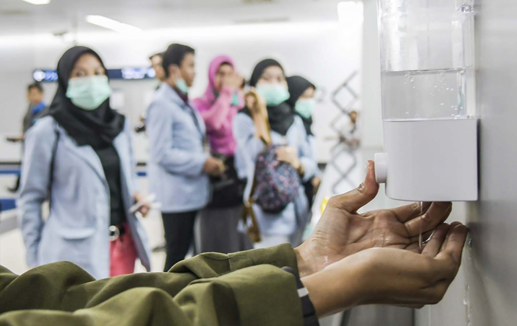
Mandatory halal certification could restrict the distribution of disinfectant products needed to fight coronavirus Covid-19 in Indonesia, where almost 90% of the population is of Islamic faith.
Ethanol is a key ingredient in the World Health Organization (WHO) recommended sanitiser ingredients list but is also an intoxicant prohibited under Indonesia’s recently enforced halal product assurance law No 33/2014. This law requires mandatory certification for a wide range of products, including hand sanitisers.
An article of the law does allow for the sale of products clearly labelled as non-halal. But Muslim users may feel compelled to reject these in favour of halal-certified products.
The Indonesian Ulema Council Assessment Institute for Food, Drug and Cosmetics (LPPOM MUI) under the Religious Affairs Ministry has been responsible for the voluntary certification of halal products to date and recently issued guidance that: "As long as it is not from the 'khamr' industry, the use of alcohol/ethanol is permitted or may be used for external use, such as in hand sanitiser."
The Arabic term khamr is generally interpreted as referring to intoxicating fermented alcoholic beverages. This suggests that only ethanol produced by hydration of ethylene or industrial fermentation (for non-beverage purposes) is acceptable for use in halal-certified products.
The LPPOM MUI also highlighted the need to check the sourcing of glycerin moisturisers and fragrances in sanitisers. If the glycerin is derived from animal fats, these must come from halal animals slaughtered according to Islamic law. The use of natural fragrances extracted with unacceptable alcoholic solvents or synthetic fragrances derived from non-halal animal fats, might also prohibit halal certification.
Implementation status
In May last year, Indonesia issued Government Regulation No 31 of 2019, which enforces the halal product assurance law first issued in 2014. The law mandates halal certification for all:
- food and beverages;
- cosmetics;
- pharmaceuticals;
- biological, chemical and genetically modified products; and
- wearable goods.
To obtain certification, companies must follow strict requirements for sourcing raw materials, processing, storage, packaging, distribution, sales and serving of products.
The originally proposed measures drew strong criticism from local industry and abroad. The EU delegation to Indonesia noted the "far-reaching and draconian nature of this law and the potentially high burden it will create on business."
Following consultation, the government extended the original five-year implementation period for some products. Producers of food and beverages will be required to obtain certification by 17 October 2024, and of other products by 17 October 2026.
A new organisation, the Halal Certification Agency (BPJPH), was created to handle certification of products, but the LPPOM MUI continues to play an important role in the certification process.
Companies seeking halal certificates for their products should submit a written application to BPJPH, which will assign a Halal Inspection Agency (LPH) to inspect the product and issue a certificate based on the results.