



 © Chemical Watch Events & Training
European Commission initiatives to support the EU chemicals industry, including its omnibus and Critical Chemicals Alliance (CCA), may not be enough to restore the sector’s global competitiveness without broader regulatory simplification, speakers at a conference this week said.
The debate centres on whether simpler rules can encourage investment and the uptake of alternatives without weakening environmental or safety protections.
The executive is taking steps via the Chemicals Omnibus and the CCA to strengthen the sector’s competitiveness "in a sustainable way", as it faces "an unprecedented storm", Kristin Schreiber, director for chemicals and bioeconomy in the executive’s DG GROW unit, said.
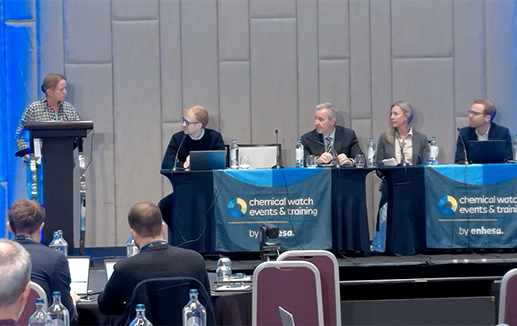
At Chemical Watch Events & Training’s Regulatory Updates Europe conference on 19 October (pictured), speakers linked the EU chemicals industry’s declining global market share and recent plant closures to the Covid pandemic, Russia’s invasion of Ukraine and the energy crisis. Conversely, chemical industries have grown in other regions.
Against a backdrop of NGO concerns about industry influence on Commission decisions and their withdrawal from the CCA, Schreiber said that the omnibus packages aim to reduce unnecessary regulatory burden: "The simplification we have in mind is not about lowering environmental or safety standards [...] Smart simplification can help us achieve these [objectives] better."
Schreiber said a network of innovation and substitution hubs would accelerate the development and uptake of safer and more sustainable chemical technologies, help replace hazardous substances with safer alternatives and promote circular and bio-based solutions.
"Wherever possible it will be guided by the safe and sustainable by design framework," she added.
Global comparisons
But the EU’s overarching legislative process takes time, with industry and other stakeholders bemoaning its complex nature.
Christos Vasilakos, head of office to MEP Dimitri Tsiodras, cited findings from a 2024 report by prominent economist and former president of the European Central Bank Mario Draghi concerning the vast differences in legislative adoption.
The report said the US enacted around 3,500 pieces of legislation and passed around 2,000 at the federal level over the past three Congress mandates (2019-24). During the same period, the EU passed around 13,000 acts, according to Draghi.
"It says something: it says we should stop regulating everything," said Vasilakos. "We have to simplify our work; we have to provide our industry, our citizens, with better provisions."
The lesson for Europe is clear, he added: "Our competitors are not relying on regulation alone. They are actively creating the conditions for industrial investment, technological development and manufacturing. It is something we have to do as Europeans."
Hans Ingels, head of unit bio-economy, chemicals and cosmetics at DG GROW, said that when the Commission is developing policy, "we try to look at what is happening internationally. We can very often learn from what is happening in [...] the US, Canada, Japan [and] Australia."
However, the EU faces the difficult task of developing single market rules that work across 27 member states and the four European Free Trade Association (EFTA) countries, Ingels said. Such rules are valuable, "but very often they are becoming too complex", involving proposals, consultations, and delegated or implementing acts that set deadlines for the Commission.
"You have to adapt to new circumstances and continue things that were laid down in law but have been outdated already after a few years," he said. "If you go too much into complexity and go very much deep down into technical rules, you actually stifle innovation and prevent businesses from flourishing."
Common understanding
The European Chemicals Industry Action Plan, adopted in July 2025, remains the Commission’s guide, Schreiber said, giving the executive a "clear sense of direction".
Schreiber said the focus now is on implementation, with the CCA serving as a consultative body to help steer the Commission’s work.
She added that the road ahead is not straightforward, but "we have a very good common understanding of what our objectives are, and we now have to make sure that we manage to deliver [them]".
High standards
Ingels discussed the international response to the EU’s new hazard classes under its CLP Regulation during meetings of the UN’s Globally Harmonized System of Classification and Labelling of Chemicals (GHS). He said the Commission has "got the impression that there’s little or hardly any interest [in] follow[ing] the EU".
Ingels added that fewer meetings and staff were being devoted to the discussions and that representatives "basically refuse to address the new [CLP] hazard classes".
Ingels said the EU developed these new hazard classes, in part, to give certainty to businesses in terms of definitions of endocrine disrupting substances. "We are fairly unique in the world, and I think this is something very valuable that we need to protect but, in GHS [meetings], personally what I see is very disappointing," he added.